Decisions, Devotion and Destiny

Today marks two years since my Mom passed away. I still hear her voice but her singularly calming, practical presence is missing. Her bluntly honest remarks often caught people off guard or made them laugh (if not a little bit uncomfortably). I don’t know too many people who are both blunt and smart. Generally, I just feel disappointed with the world and miss Mom especially because her confidence and clear communication was always one thing I knew I could rely on in this world.

I have become permanently impatient with people who are reluctant to make decisions – or more precisely – accept responsibility for making them, when it seems like such an important time to respond to the urgency in our world. The last 3 jobs I have held all curiously presented the same set of frustrations: people “in charge” who wanted authority but either had no desire, impetus or wisdom to exercise their authority. I would bring important issues to leaders that impacted my day to day (and would result in wasting resources if left spinning indecisively) only to be pushed off for some future date when making a decision would become clearer for them. What? I remember thinking, “Dude, you are literally being PAID to make DECISIONS. Like, that’s your JOB!” as I walked away in frustration. But the universe continued to present this frustrating set of circumstances to me over a period of several years in jobs I grew to strongly dislike – so there must be a good reason, eh?

I have concluded that this lesson repeatedly appeared in my work life because there was something else I needed to be doing. Primarily, listening to my own voice and cultivating the “meaning” that I found so disappointingly missing elsewhere – within myself. As a woman approaching 60, it’s fair to say I have spent two decades devoted to my family. Not just the person who made sure tasks were completed – but real, geniune, from the heart devotion – the kind you feel towards your first love. As an empty nester, I’m still very devoted to children. On this rainy morning of the anniversary of my Mom’s death, I just returned from delivering a birthday package and cake from Birthday Connections to a child in need who currently lives in a domestic violence shelter. I feel really good about having the privilege to be in a place in my life where I can play a small role in uplifting another person and be true to something I feel devoted to in my heart. I think Gen Z’ers would call this “Alignment.”
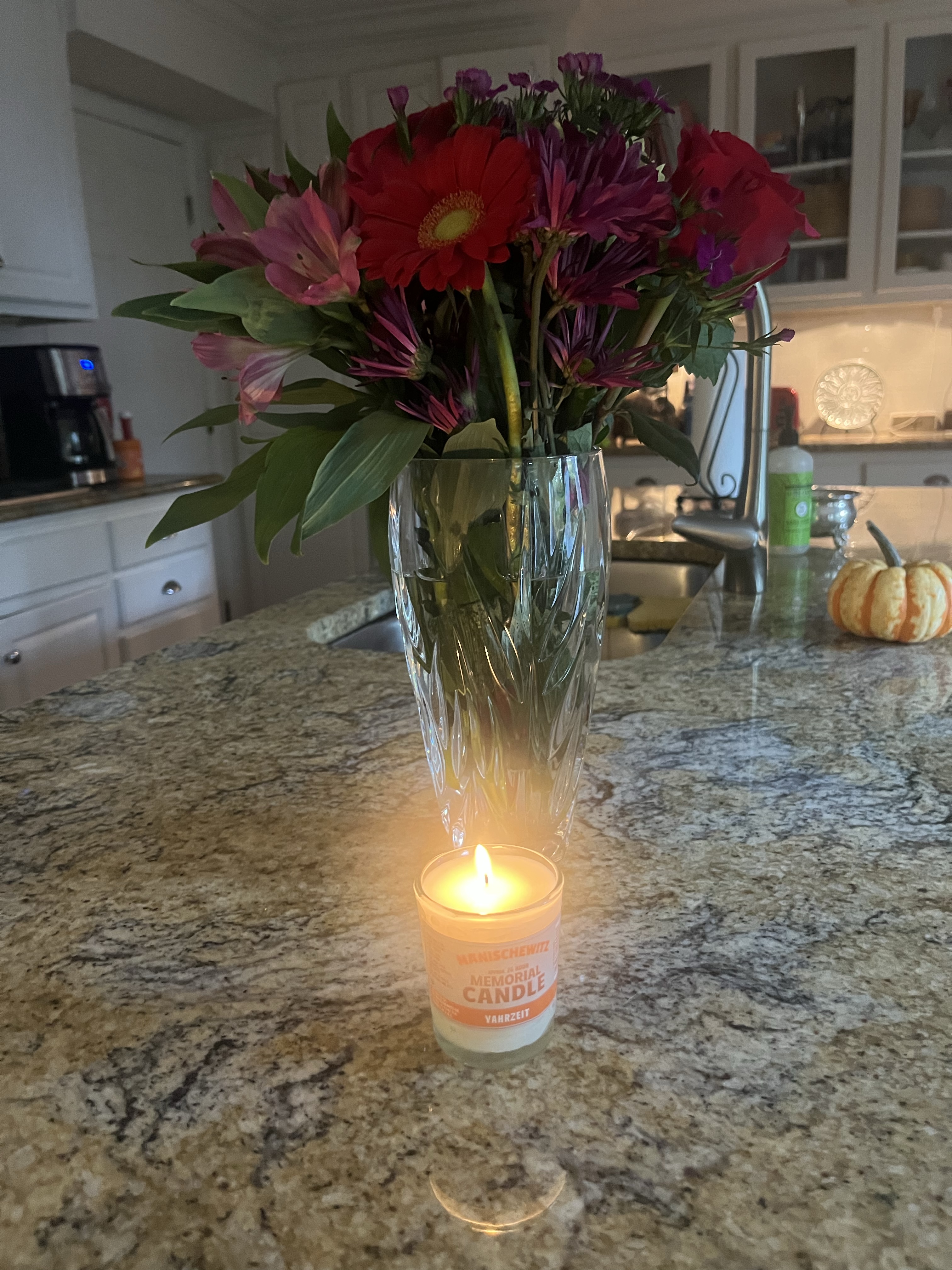
A new friend of mine surprised me yesterday with a “Yahrzeit” candle – a memorial candle in the Hebrew tradition to light on the date of a loved one’s passing and keep lit for 24 hours of remembering, honoring the deceased, performing acts of charity in their memory, etc. I had already intentionally chosen to volunteer today for Birthday Connections as a way to honor my Mom, who successfully nurtured and raised seven children. But the Universe really wanted me to “get” this lesson, so my friend Shelly, who has experienced much loss, generously opened her heart and gifted me this beautiful and gentle tradition. I am so grateful and deeply comforted by her kind act. In the Christian tradition, lighting a candle is a form of “devotion” – recognizing the sacred in another person and memorializing their goodness through prayer and remembrance. It isn’t even noon yet and already I can say I have fulfilled the mission of this day – and will spend the next several hours in gratitude and restful contemplation.

We are all born to discover our unique gifts. As Ralph Waldo Emerson beautifully writes in an essay:

“Rings and jewels are not gifts, but apologies for gifts. The only gift is a portion of thyself. Thou must bleed for me. Therefore the poet brings his poem; the shepherd, his lamb; the farmer, corn; the miner, a stone; the painter, his picture; the girl, a handkerchief of her own sewing.”

The gift of intentionally (decisively) honoring my Mom’s memory today and practicing devotion in her memory by supporting a local child in need brings me to my final thought – my destiny. I honestly am starting to believe that my destiny in life is to be a “feeler of big feelings” and conduit for people who may not recognize or articulate their own. In other words, I’m the uninhibited person in the room who will say something awkward that is maybe cringe but also funny – and potentially touches another person’s heart so that healing can begin. So far, I have been fortunate to be able to recognize mostly good things from the painful experiences I have had in life. And without fail, honest and good-hearted people have met me along the way to help me make sense of recent losses and pain.

I will conclude with a thought about recovery. Lately I have been thinking that I have not been very “emotionally sober,” even though I do not drink alcohol anymore to survive big feelings. There have been a couple of major losses in a short period of time in my life and many days, I find myself “growling” at the world instead of living in gratitude and bowing in reverence towards my good fortune. This is why I am considering going back to a 12-step recovery program and actively working the steps of AA. An old friend has recently reappeared in my life and kindly offered to accompany me as I start this journey over – in search of emotional sobriety. Rolf Gates, a brilliant yoga instructor and recovery writer, writes in his “Daily Reflections on Addiction, Yoga, and Getting Well”:

“Much of early recovery was like finding the bodies trapped in the snow after an avalanche. Frozen in their last moments – new boots, worn parkas, bits of scarf. My sadness was overwhelming. My 12-step sponsor, Henry, knew this about me. He was kind to my sorrow. There were no answers for what broke my heart. There was no getting any of it back….

….Henry would look at some broken part of my life, lift an eyebrow, and drawl, “what is was like.” We would laugh until tears came to our eyes at what it was like and would be no more.

Reflection:

Life has put people in your life who have not been afraid of your sadness. Thank them with your heart. Maybe thank them in person. Who has helped you laugh the laugh of freedom?”

The people who are appearing in my life who are not afraid of my sadness are helping me heal and discover new ways to use parts I have previously discarded and labeled “broken.” To me, this is a destiny worth fighting for and enjoying.


Hello, Whimsy!

In 2 weeks, I will celebrate TEN YEARS SOBER!! Getting sober was the single most impactful (and difficult) thing I have done in my life. I have 10 years of supporting evidence that I will not bore you with, you will just have to trust me. TRUST is the operative word because before I got sober, I had forgotten how to trust myself. Walking through life distrusting one’s own impressions, intuitions, thoughts and feelings can lead to long-term nervous system dysregulation and persistent and extreme feelings of anxiety, burnout and depression. This was my life off and on, even during periods when I was not binge drinking, for 40 years.

Shackled to my own perceptions of existential threats, I once experienced life as a daily pop quiz for which I was unprepared. Why didn’t I trust myself and my own unique strengths and capabilities? How could a person ever learn to hang their self image on the validations of others? I think you have to begin teaching children in early childhood ways to reassure themselves that they are safe and supported. Allowing self-expression of “big emotions” instead of punishing disruptions in the day helps children learn that, even though they are not “big people,” their fears, needs and feelings are valid, important and worth pausing with a safe adult to co-regulate. This was unheard of in the 60’s, 70’s and 80’s when I was growing up. So dysregulated people often reached for ways to numb those big feelings they never learned to trust and process. Hi, my name is Joan, and I’m an alcoholic.

10 years ago I did not have this clarity about how I had developed such a dysfunctional relationship with alcohol. I only knew that if I did not find sustainable recovery, my family was doomed and I would forever regret it. Self-blame came second nature to me, so I just assumed I was a weak and flawed human, incapable of “controlling” my alcohol intake, so I first stepped into recovery full of guilt, self-loathing and shame. Not very pleasant or motivating emotions to sustain recovery, to say the least.

If I have learned anything these past ten years it is this: you absolutely cannot hate yourself into changing. Long term, sustainable recovery from addiction requires lovingkindness towards oneself – it’s like building a real foundation of stone instead of pretty rainbows that can vaporize the moment the atmosphere changes.

To create a loving space for myself to understand and change the ways I have sought safety from my own fears and anxieties through alcohol and in unhealthy relationships, the best tool I have discovered is practicing mindfulness. Buddhist meditation and mindfulness/lovingkindness teacher Sharon Salzberg talks about “add ons” – all the mental and emotional fears, biases, beliefs that we overlay onto our present experience, in a talk she gave to to the Mindfulness Association called “Look for the Add Ons”:

“One classical meaning of mindfulness is a quality of awareness where our perception of what’s happening in the present moment is not distorted by bias. So old fears, old habits, projections into the future – whatever it may be – may well arise – but they don’t take over. A very common one would be something like feeling a physical pain or heartache and immediately thinking, “What’s it going to feel like in ten minutes? What’s it going to feel like in a week? What’s it going to feel like in a month?” So we are not only experiencing the actual distress of now – but we are now adding all that anticipation to it, often feeling just overcome and defeated. And giving up. So it’s not that the pain feels glorious. And it’s not that the impulse to add on will rise, but it need not take over. ” She goes on to tell a story of a time she was teaching with Joseph Goldstein when a person described tension they felt in their jaw and concluded that they would “I am an incredibly uptight person and always have been and always will be. And I have never been able to get close to people and it will never change.” Joseph responded, “You mean you felt a lot of tension in your jaw. Why are you adding a miserable self-image to a painful experience? ” In this exchange, Joseph Goldstein kept reminding the man of his experience in this moment, only to be met by ever more elaborate stories (add-ons) by him. He concludes, “It is geniuinely painful to feel the tension in your jaw. But on top of that, you are now going to be alone for the rest of your life.”

“In mindfulness meditation, we look for the add-ons. We look for what might be added on to the direct experience and see if we can relinquish the hold of those add-ons. It’s not that they won’t arise, they won’t be tempting – but they needn’t take over.”

I was 49 years old when I decided to get sober and my children were 14 and 16. It was a very busy time in our household. My husband was working hard re-building his law practice after an 8-year hiatus. My daughter was exploring her independence as a new driver with friends I did not know very well. And my son was struggling with his own anxiety and depression and desperately needed a healthy, attentive, responsive caregiver. I told my AA sponsor more than once, “How can I take care of myself right now when my family needs ALL of me?” It seemed insurmountable to do both. “Take care of yourself first and the rest will fall into place,” she repeated to me hundreds of times. This was counterintuitive to me and required a leap of faith. I felt enormous guilt for “being flawed” and “inadequate.” Those feelings, I discovered many years later became huge add-ons. Just because in the moment I was feeling flawed and inadequate, I made the hugely illogical conclusion that I was permanently incapable of changing. That’s not a great mindset for quitting alcohol, let me tell you!

Like this beautiful lilac bush that was once a tiny sapling from the Wal-Mart garden center I had forgotten I had even planted in the home we left behind in 2010, little by little, and with lots of practice and support, I started to grow and feel better. When I look at this photo my friend Lorna recently shared to show me its progress (current resident of the country home we build and lived in when the children were very young), it strikes me that is is a metaphor for my life emerging from addiction into sobriety. Looking at it I see a hint of the whimsy I so enjoy about life. And it brings me back to my purpose in life: to enjoy the beauty of each moment and attempt to capture some of that whimsy for those I love.

You can’t experience whimsy if you are stuck in the weeds of add-ons, afraid to feel your feelings in the moment, knowing that they will always rise and fall and throughout, you will be okay. I see today how narrowly I escaped never feeling whimsy again had I not listened to my inner voice urging me to find a better way to live 10 years ago. Whimsy is essential to living a full life.

“People who are full of whimsy are odd, but often fanciful and lovely,” (according to Google!). I like home best with my dog, cat and family, nestled in by the fire with pretty lights and books. Simple joys bring lasting comfort and don’t require wine.

How did things turn out for my family, ten years after the turbulence that led to my decision to get sober? Beautifully. Somehow, with lots of support, I was able to simultaneously take care of myself and my family and give them what they needed. We are close and loving and enjoy laughing together. Whenever one person is hurting, we all feel it and find ways to support one another. My lifelong dream of building a happy family is fulfilled. As I approach my 60’s as a sober person, I plan to make whimsy more of a priority. This could show up as homemade jam I gift friends and family or a day trip to visit Clydesdale horses “just because.” I don’t take it for granted – this whimsy has been hard earned!

The work and the whimsy will continue. I am hoping they yield entertaining stories to share with the world.

Truth

When I was very young, my Mom let me go on a mini adventure one afternoon with a nun from our small town parish. Her name was Sister Arthur, and like the name suggests, she had a (in my mind) tall stature and commanding presence. For reasons to which I was never privy, it was determined to be a good idea for me to join Sister Arthur on a little field trip about an hour away from home to an ancient Indian burial ground in search of treasures. What precocious child wouldn’t want to venture out for such an adventure?

As best I can guess, Sister Arthur must have taken me to the Towosahgy State Historic Site in East Prairie, Missouri. According to the Missouri State Parks website, this location is “surrounded by some of the most fertile farmland in Missouri….a former fortified village and civic-ceremonial center for Mississippian peoples who lived in southern Missouri between A.D. 1000 and A.D. 1400.” I believe what is pictured is what my young eyes saw that day. While I cannot remember anything Sister Arthur said to me that day, I vividly recall feeling a sense of wonder and reverence. The sight of her hands holding an arrowhead and telling me something about how it was made and its purpose is emblazoned in my memory, though exact words I cannot recall. I just remember feeling very special to have been chosen for this wondrous one-on-one field trip. I always wondered, “where have all the people who used to live here gone?”

The impact of that single exposure to something so massively important to civilization sparked a curiosity in me about excavating artifacts. I began digging and searching around my home and surrounding farmland for similar treasures, only to come up with handfuls of limestone rock, usually. That Christmas my grandmother nurtured my curiosity and gave me a rock polisher. While I never returned to the sacred Indian mound, I imagined treasures of my own from mini digs I conducted in the fertile farmland around my house. I never found another arrowhead but I will never forget the spark of interest Sister Arthur ignited that afternoon so long ago. The idea that it was possible to unearth tools that gave clues about how people thought and lived thousands of years before you was the first evidence I had ever encountered that people really are all connected.

I’m 58 years old now and have recently become reacquainted with that budding archeologist who spent the afternoon with a “scientific nun” so many years ago. I recently lost my Mom, the first person to believe me worthy of such an important field trip (or maybe she just needed an afternoon alone!), and what I keep returning to is the importance of excavating the truth. Instead of artifacts, through yoga, I have begun searching for the truth about myself. Hip pain led me to yoga and fate or serendipity or both led me to the Yoga Teacher Training I have been involved in for 3 months. One truth about myself I live with everyday is my former addiction to alcohol and the shadow of lies from that always nearby.

To maintain sobriety is to commit to the daily discipline of pursuing the truth. Lies can be alluring hiding places but they always betray you when you want protection the most. Through yoga, I have been introduced to the brilliant writings of Rolf Gates (“Meditations from the Mat”). A few days ago, I read and reread Rolf Gates’ reflection on self-study (“svadhyaya” in Sanskrit, meaning self-study and one of the five sustaining practices in the practice of yoga).

“The unconscious wants truth. It ceases to speak to those who want something else more than the truth.” Adrienne Rich

“Self-study is an aspect of the practice of truthfulness……The good news is that truth is music to the soul. There is no end to the soul’s ability to bask in the presence of the truth. Millions of people in twelve-step programs sit around in church basements by the hour, listening to one another talk about themselves. It may sound boring, but in fact it is captivating, because the people in those rooms are telling the truth. It is captivating because spending time in the presence of others who are telling the truth inspires us to do the same.

To practice this aspect of self-study, examine the level of truthfulness in your workplace, family, and friendships. How much time do you spend in the presence of people who are telling the truth? How much do you spend with people who are not? What is it like when you hear the truth? What is it like when you do not? What fears keep you from being honest? Is it true that like attracts like? Does honesty beget honesty?”

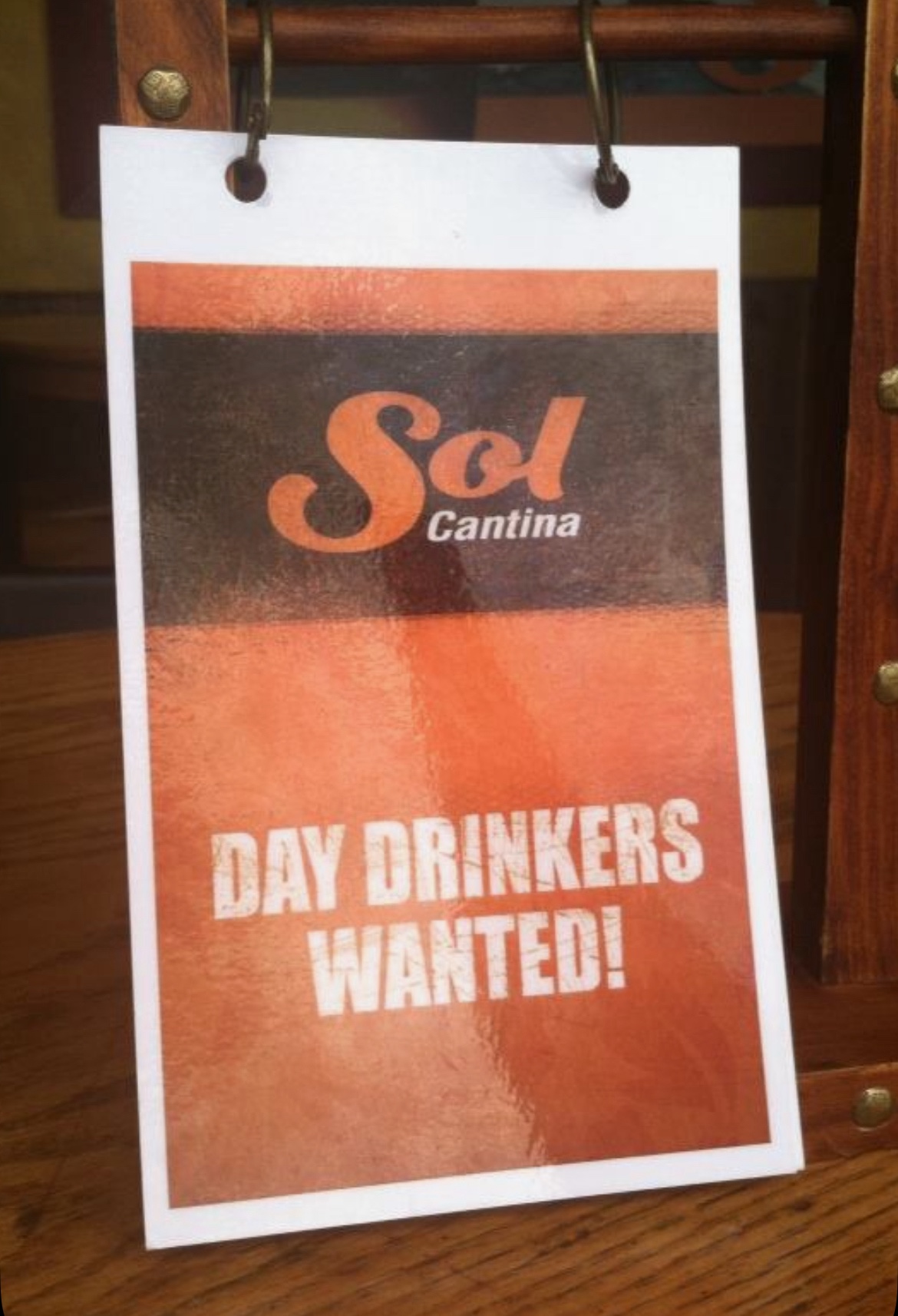
Today, as I celebrate my ninth year of sobriety, my Google pics showed me this “funny” photo I took at a restaurant exactly 11 years ago, a time when I was deceiving myself about my truth. I thought this message about day drinking was funny. I thought by throwing my life away each day, little by little, I was really having fun and attracting the right people and things in my life. It makes me sick I once believed that throwing my life away in front of my children and husband was “funny.” There is nothing funny about not being able to live your truth.

As I have slowly excavated my truths and begun building a life of honesty and authenticity, I have observed the impact of this commitment on the people I love. It has had opposite effects: some people have thrived and grown and others have recoiled and shut me out. I’m never going back to not living my truth. If you had told me at the beginning of my sober journey 9 years ago that I would one day be working at my favorite organization and pursuing a yoga teaching certificate, I probably would have tried to protect myself with a “joke” about needing wine or margaritas or some other distraction to sustain me. I wouldn’t have been able to see myself living a happy, healthy, truthful life because to me that seemed so far out of reach in addiction. My familiar pain was more comforting than the effort excavating truth sounded like.

I have found truth in the eyes of the people with disabilities my workplace serves everyday, on my yoga mat and at home with my beautiful family. Most importantly, I wake up and go to sleep each day thanking the spiritual connection that sustains me for helping me to face the truth one day at a time. In addiction, I forgot to love that adorable little girl who was so curious about life and interested in excavating truths. She wasn’t worried about what anyone else was doing, thinking or saying because she was so completely enraptured by nurturing her own loves. I recently excavated this child and oh, what a fun adventure we are beginning.

Thoughts About National Drink Wine Day

This morning as I was going through my Facebook memories (sadly the best compilation  I have of all my recent goings-on socially and in general), I saw a post from 2017 of myself drinking coffee as an act of rebellion against “National Drink Wine Day.”  “Bravo, You,” I said to myself, for I have achieved nothing in my life that didn’t include a little sense of rebellion against authority, status quo, ridiculousness.  What surprised me after a quick Google search was that 3 years later “National Drink Wine Day” is still a thing in America.  This, in spite of the fact that American women age 40 and older are the fastest growing group of alcoholics (or persons with alcohol use disorder, if you prefer) in our country today.  Right along with alcohol use disorder rates of liver disease, cancer and heart disease are rising because of the poisonous levels of toxins we barrage our bodies with when we drink alcohol.  But sure, let’s celebrate that “win” and Rose all day. Or not.

I’m not bashing the right of people to enjoy their wine whenever they want.  Lord knows, struggling to stay sober for the past years, I have learned to accept that people will continue to drink in spite of evidence it is bad for them, just like smoking.  It’s the cultural acceptance of self-sabotage that I don’t accept, hence these brief thoughts from a Woman in Recovery on a national day designated to celebrate what for many of us is simply a sad existence.

Like any revolution, great thinkers and role models are emerging from the non-drinking community.  I am reading Holly Whitaker’s “Quit Like a Woman:  The Radical Choice To Not Drink In a Culture Obsessed With Alcohol” currently.  She compares today’s rising rates of alcohol abusers (binge drinking among women is at an all time high) to the era when Big Tobacco spent massive amounts of advertising dollars to convince consumers cigarette smoking was a safe, adventurous and romantic complement to anyone living a full life.  Our collective thinking has come very far since the “Don Draper”Mad Men  days where drinking and smoking throughout the business day were considered well-deserved rewards for hard work.  Yet alcohol continues to hold a powerful grip on so many of us it is considered a “radical choice” not to drink these days.

I will tell you this, if I had not stopped drinking a bottle of red wine every single day in 2015, I would not have the great life I have today, and I am 100 percent confident my family would not be anywhere near the great shape they are in.  People who quit drinking, even for a couple of weeks, rave about the better sleep and greater clarity they have after just a short time changing their habits.  All I am saying is, I hope you will consider that there are big companies that do not have your best interests at heart that are benefiting from this campaign to celebrate drinking alcohol.  And you don’t have to accept that.  My life is proof of that.  Today I have stronger friendships and a far greater day to day existence that a few years ago when I was “life of the party.”

No substance can substitute a real life, from the highs to the lows.  And it may surprise you to know that, without alcohol doing a number on my blood sugar and energy levels everyday, I am able to think more clearly, stepping back before reacting to everything I experience, and I certainly bounce back from bad days much faster than I did in my drinking days.  I’m not celebrating “National Drink Wine Day” because I have found a much better way to live without wine and I love my life now.

If you care to join me, I’ll be having a quiet cappuccino this afternoon in a warm and sunny spot to celebrate the Resistance to National Drink Wine Day.  All the cool kids are sober.

No, Deb, We’re Actually Not Playing in the Same Sandbox

I’ve written about the long period of time when my kids were young when a few businesses my husband was involved with simultaneously combusted – leaving our lives scattered in pieces to salvage the best we could.  So I won’t bore you with the story again except to reference an odd phrase one of my husband’s employees repeatedly used in conversation with me to convey – I am not sure what – “We’re all playing in the same sandbox!” she would exclaim every time she saw me.  Um….was it solidarity?  Compassion?  Manipulation?  Honestly, it annoyed me because we were SO NOT in the same “sandbox,” figuratively or literally.  There were disastrous and long-term financial and professional consequences from the partnerships and businesses that fell apart that affected many people – just not so much “Deb.”  The memory of this strange interaction tumults my consciousness back to a feeling of deep isolation.  And that’s when the addictive thinking began.

I mention this because I want to talk about trust and friendship and understanding.  These are the best contexts for me to share with you that recently I chose to have a couple of glasses of wine.  Relapse.  That’s what my Therapist calls it.  I think that is a brutal word, especially since some of the recovery literature and support groups make it sound so hauntingly awful – and shameful.  I am not ashamed that I wanted 2 glasses of wine ….. twice lately …. and that I gave in to my desire.  My Therapist wants to make sure I understand that the “relapse happens in the thinking a long time before the behavior” – and I do.  I will be honest, both times I drank I felt utterly terrible physically for 2 days after.  Nor did I get the “fun buzzed” feeling I recollected and longed for.  Just swallowing a sugary drink in hopes of recapturing a feeling of escape.  But the feeling never came and the after effects were awful.  So I don’t think I will be doing it again.  Yet my Therapist and I both want to know why I did it.

Isolation and not feeling connected are the roots of my addiction.  When I look around at the true friendships, real connections, and budding feelings of purpose I have at this perfectly awkward midlife time of life, what I have is good.  REALLY good.  I just don’t seem to want to accept it, if that makes sense.  My friend Shelley, a dear old friend with whom I have recently reconnected, helped me see something about myself glaringly obvious to her:  my addiction must have somehow also been driven by the desire to escape from the natural physical changes women experience in midlife. Yes, Shelley, yes! You are right!  Her compassion, insightfulness and kindness led to tears streaming down my face when she said:  “You are probably just now, in your sobriety, learning to accept your body and wrinkles for what they are while other women your age have had more time to adapt.”  Bingo.  I’ve written about taking dexedrine (pure speed prescribed by a doctor) for (I can’t even remember the bs diagnosis – something like “unresponsive depression”).  I was super skinny then.  Now I am hungry all the time.  But if you compare my overall health today to what it was during my skinny and addicted years – I am far healthier, though more plump, today.  Shelley is helping me understand “you are not supposed to look like you did 25 years ago.”  My body today is not a “mistake.”

I think comparison is the reason why I relapsed.  “Everyone else” is having so much fun drinking and having fabulous bodies.  I hope you are laughing because I am!  Our addictions will tell us lies about ourselves and others all day long if we let them.

What will I do now?  I will work harder to accept and love myself.  I have learned so many things from this journey but it takes time and effort to put it all into daily practice. Drinking is and always will be a problem for me.  When I drink, I am not my authentic self and it is difficult for me to get back to that.  Some of today’s “spiritual junkies” tout that “Calm is my superpower.”  And that sounds attractive.  I want it.  Like sobriety, I will do anything to get it and keep it.  Now back to work.

The Practice of True Belonging

Lately I have reflected alot on Brene Brown’s definition of “true belonging” from her latest book, “Braving the Wilderness”:

“True belonging is the spiritual practice of believing in and belonging to
yourself so deeply that you can share your most authentic self with the world and find sacredness in both being a part of something and standing alone in the wilderness. True belonging doesn’t require you to change who you are; it requires you to be who you are.”

There is a big whopping heap of wisdom in that one little definition! Consider it from the framework of a marriage: a happy and successful “union,” some say, is the sum of two whole parts. Both partners are complete going into the union. What about the years when outside influences and family responsibilities gnaw at the core of one’s “whole self” – what about times when you are giving so much of yourself, you feel lost inside your own home?

This happened to me when a series of overwhelming challenges happened in rapid succession. Not only did I not belong to myself, I felt separate from the “wholeness” of marriage. Alone and terrified. Money, kids, health, work, geography and all kinds of other mini-challenges crept in my life and the me I was once so solidly familiar with started to disappear. Often weary, I dulled my fighting impulse with red wine. I thought I was stronger (i.e., belonged more authentically to myself) when I was drinking, but this could not have been further from the truth. I forgot how worthy I was of a happy life, so I drowned all my dreams and ambitions in alcohol. Fortunately for me and my family, a spark of life remained and I woke up in 2015 to the realization that I had made a big mess trying to comfort myself through numbing rather than belonging. I was in a crisis of disconnection.

Brene Brown continues her definition of true belonging”

“True belonging is not something that you negotiate externally, it’s what you carry in your heart. It’s finding the sacredness in being a part of something and in braving the wilderness alone. When we reach this place even momentarily, we belong everywhere and nowhere. That sounds absurd, but it’s true.”

I wonder if the quest for “true belonging” isn’t the biggest challenge we as humans are meant to overcome. It seems so simple but the piece that brought me back to myself and the living world and my family was finding the sacredness in being a part of something. Somehow I had internalized the message early in life that belonging equaled weakness so when the road of my life got very twisty – I retreated into myself and stopped connecting.

Many addiction experts believe that the opposite of addiction is not sobriety – it’s connection. I wholeheartedly believe this to be true. The joy of connection is an equal opportunity healer – yet for some, the most difficult to attain. If you are around enough people who suffer from addiction disorders, you will likely hear it repeated that they are grateful for their addiction because it led them to this awareness that true belonging to yourself so deeply that you can share your most authentic self with the world.

Living a sober life after years of dulling the brightness of the real world truly is an adventure in re-connecting with the child you once were and the loved ones you travel with. I am grateful to Brene Brown for helping me to clarify the importance of true belonging, it is the foundation for my whole life now.

Getting Sober Is Like Starting A New Job …. Everyday

Next week I will celebrate my 2nd consecutive year living in long-term recovery from alcohol use disorder.  Notice my language.  It is very specific for a reason:  I believe that I will spend the rest of my life working to develop deeper understanding of my need to numb feelings and, hopefully, will be granted the Grace and inspiration to pursue ever-deeper practices for managing and maintaining a healthy, well-rounded life without relying on alcohol.

I am so proud of this achievement yet I know that I could “slip” at any time if I begin to neglect the positive practices that keep me humble and eager for continued sobriety.  Just like a person who has changed jobs, my openness about my struggles is just one of many facts about my life – in other words, sobriety will never define me as a person.  Yet, surprisingly, maybe because of tv shows like “celebrity rehab” or the heavy infiltration of 12-step type phrases in popular culture, it has been my experience that people automatically have their own sets of expectations of what your recovery should look and feel like.

It is impossible to convey to a person who does not have addiction controlling their life the excitement and liberation you feel once you decide to change, accept your limitations, and work everyday to seek newer and better ways to live “a normal life” without obsessing over wanting to numb.  That’s why I write about it.  But it makes people feel “awkward,” it seems.  So I am supposed to confine and limit my experience to groups of other “users.”  This does not make sense to me.  You wouldn’t avoid talking to a person about their new “job,” so why would the topic of pursuing a life without addiction be any different?  This is why maintaining sobriety can be difficult – it is more “polite” to ignore the addiction monster in casual conversation.  This kind of sweeping under the rug behavior is bad for our children.  They need to hear us talking about and showing them what a life built on zero reliance on alcohol looks and feels like.  Just like we introduce our children to the concept of work by taking them to work  with us, we should not be afraid to declare our commitment to sobriety to our friends, family and community.

The reality is that the younger a person is when they first experience alcohol, the more likely it will cause an addiction problem later in life.  We don’t perpetuate self-sabotaging cycles in other health-related concerns (for instance, heart disease), so why are we reluctant to openly discuss and support addiction and sobriety?

I have a suspicion it is because many of us believe one of two things:  that we are already slipping into bad habits of relying on alcohol to “numb” difficult emotional situations or we mistakenly believe we are immune to addiction.  Those are highly dangerous beliefs.  I think another reason people don’t want to talk about their feelings related to numbing and alcohol is because there is a widespread misunderstanding of what a sober life looks and feels like.  I will definitely admit (if you have not already ascertained this fact!) that I am a much more sensitive person sober than drinking.  I have to work hard to process my thoughts, feelings and responses to everyone and everything around me to avoid falling into old patterns of numbing.  But that doesn’t mean my life is no longer fun or that I will not tolerate others’ drinking around me (everybody has their own barometer of tolerance about this, so it is always thoughtful to ask).

Over the weekend, I felt so many “feels” as we celebrated our first-born child’s Graduation from High School.  At once sentimental and fearful, the onslaught of well-wishing from people in  your life you may still be reconciling with, the entire weekend was challenging and tiring for me to navigate.  And the past two nights, my poorly trained brain with only 2 years of sober thinking under its belt, even began telling me “You should go ahead and enjoy a drink or 2 or 10.  You don’t really have a problem.”  This is proof to me that I will spend every waking moment for the rest of my life “managing” this enormous force that lives inside of me that wants to numb everything.

Finally, some thoughts about people in Recovery that might help others better understand this journey:

Sober people are fun people;

Getting sober means the party is just beginning, not ending.

Sober People do  not intend to make you feel uncomfortable ;

Sober People would rather you throw out all your old ideas about Recovery and learn by engaging with them rather than avoiding the topic altogether;

Just like becoming confident about one’s performance in a new job, living comfortably in your own skin as a sober person takes time, and you should not have any unrealistic expectations about what this should look like – every sober person is unique.

It has been an honor and a pleasure sharing the past 24 months with Readers. I have received so much love, grace and appreciation from the many people who want to understand addiction.  This propels me forward, especially after my 99th cup of coffee during absolutely perfect cold Heineken or margarita weather!

Healing Happens in Phases: Ebbing and Flowing

So happy to bring you this insightful piece from my Recovery Friend, Rose Lockinger.  If you are new in your Recovery or simply in need of a fresh perspective, Rose’s piece reminds us to expect a journey full of twists, turns, surprises and mini-victories.  In short, like all things in life,  when doing the work of Recovery, expect the unexpected and welcome the lessons as they unfold. xoxo Joan


You know how people always say that we take two steps forward, one step back, well in no other place in my life have I found that truer than with my recovery.

My recovery, and by extension, my healing process, has been one that involves phases, there are times of growth and times of setbacks, but through it all, I have learned more about myself and what I need to heal the wounds of my life.

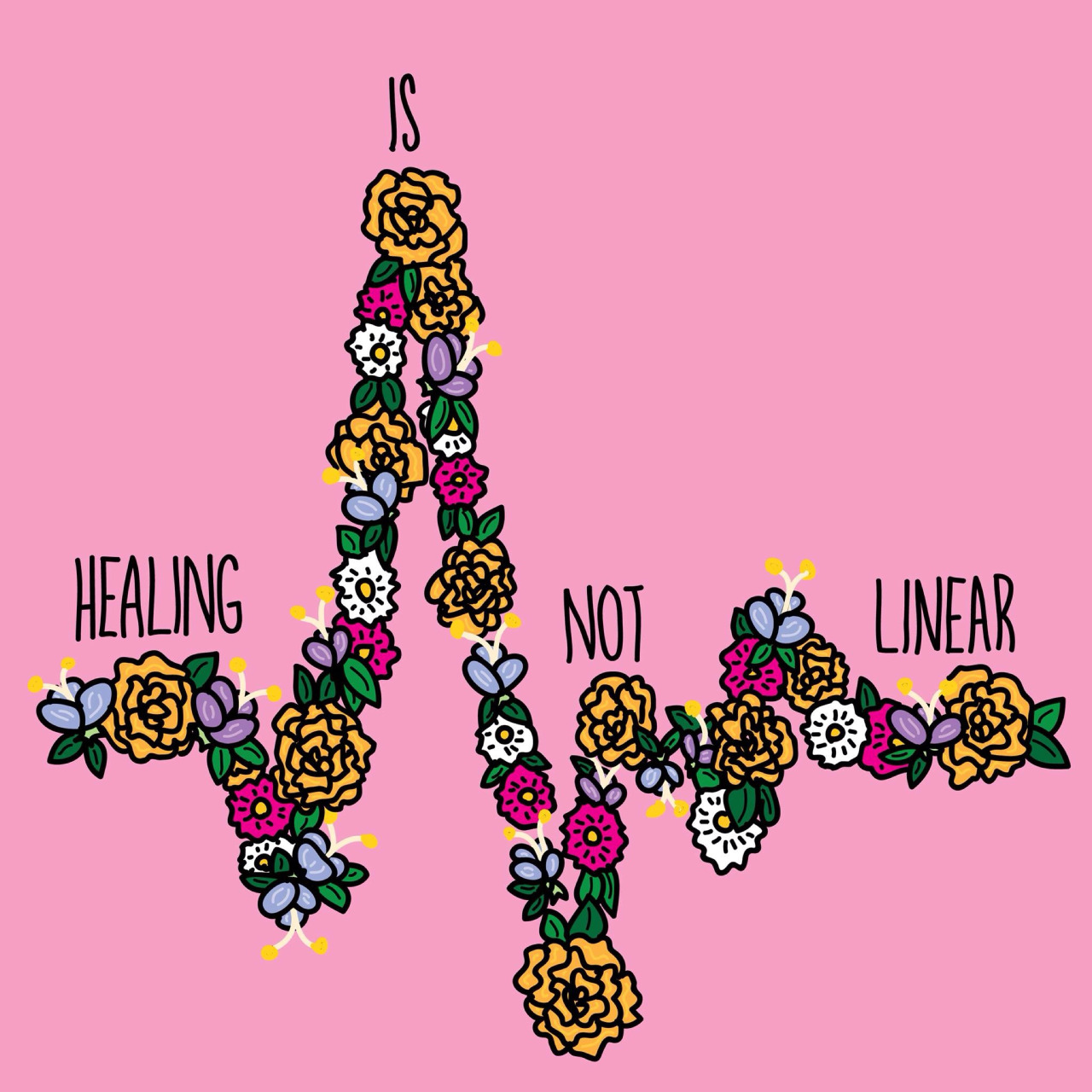
See, I have found that the healing process is never linear, although sometimes I would like it to be.  Sometimes I want to believe that it will be achieved perfectly but this is never the case.  Like it says, progress not perfection, this process of healing involves progress.  It never just continues in a straight and logical manner but rather it ebbs and flows, and there are times when I feel like I’m actually healing and other times when I feel like I am completely regressing.

I didn’t understand that this was the way of things when I first got sober and I guess I sort of believed that my life would just get exponentially better day in and day out.  The reason why I thought this way is because my life changed so dramatically and so suddenly that I just thought it would continue in this manner forever.  The Steps seemed to work perfectly and the further I got into them the better off I became.

I found that I stopped lying as much.  I stopped craving drugs and alcohol, and I even started to believe in God, in fact so much healing occurred in that first year of recovery that to a certain degree I kind of felt like I was destined to become the most spiritual being on the planet.  That I was destined to be free from all of my character defects within the next year or so, but then reality kicked in and coming down from my little spiritual hilltop, I settled into my new way of life and I began to see that not everything was being healed as quickly as my alcoholism was.  I began to see that many of the things in my life that were particularly ingrained were going to take a lot of work to get over and possibly more pain before they were ready to be healed.

I have also found that certain times in my recovery, I thought that I was healed from something, or that I had finally overcome some trauma or defect of character only to be reminded a couple of weeks later that it was still there and there was more healing to be done.  I’d get these epiphanies and believe that I understood something that would allow me to change or heal, and to a certain extent I would, but then it would just lead me to more parts of myself that need to be healed.

Without getting too far into the abstract, I sort of believe that this is the way that life works.  We are born whole and pure, without any attachment or damage and then through the process of our life we pick up damage and get hurt by people or things.  Then once we are ready, we begin the process of healing from this hurt, attempting to get back to a place of wholeness, but the process is unique and there is no set road map.  With each layer of healing that occurs another is revealed just like the peeling of an onion, and so the job is never done  It is always ongoing.

I’ll give you a recent example from my own life to help illustrate this point.  It is something that I have written about a lot and talked about even more, but has been probably the most important thing that has occurred in my recovery and has been one of the greatest sources of healing for me.

For years I hated my ex-husband, but after working my Steps I healed a little bit from the pain that I felt he inflicted on me, and so for a time I was okay.  I believed that I had achieved peace with this part of my life and in all honesty for some time, I had.  I wasn’t yet ready to really dive into that situation and experience true healing and so I only peeled back the first layer of the onion.

Then I moved back to my home state so that I could be with my kids and in doing so, I had to invite him back into my life.  Not in the sense that we were getting back together, but in the sense that we had children together which required regular interaction with him.

Being home and being around him brought up things in me that were tremendously painful and I really struggled for a number of months with this.  There were some days where I’d thought I found peace in the situation, only to have it destroyed the following day when he’d make some offhanded comment to me, or I’d find out something he said about me to our kids.

I’d go to meetings and I’d hear bits and pieces of information that I needed in order to heal from the situation and I’d leave these meetings thinking I had finally found the secret that would unlock my healing and allow me to act neutrally towards him, but this just didn’t happen.  As the months went on and the pain got greater, I continued my lurch towards healing by taking two steps forward and one step back.

Then something happened that allowed me to know that I truly had healed from the wounds of this part of my life.  I finally felt the true acceptance of who he is as a person and what the situation was.  I no longer felt anger towards him.  In fact, I just felt compassion and realized that he was doing the best he could.

Now even though these feelings seemed to just wash over me in an instant, it was months and months of moving in that direction that lead to the actual healing.  Now, this is not to say that I don’t get upset still from time to time because I do, but it is no way shape or form like it was just a few months ago.

So that’s been the story of my healing, a process that is messy sometimes and seems to move in directions that don’t make sense to me, but in the end, work towards my greater good.  Sometimes I am aware that I am moving in the right direction, while other times I’m not even sure where I’m going, but through it all, I usually wind up feeling better.

img_0174
Rose Locking is a passionate member of the recovery community.  A rebel who found her cause, she uses blogging and social media to raise the awareness about the disease of addiction.  She has visited all over North and South America. Single mom to two beautiful children, she has learned parenting is without a doubt the most rewarding job in the world.  Currently the Outreach Director at Stodzy Internet Marketing.  You can find Rose on LinkedIn, Facebook & Instagram

“Just As You Freakin’ Are?”

Remember that pivotal scene in “Bridget Jones’ Diary” when she tells her friends that Mark Darcy has told her he likes her “very much – just as you are“?  They react with wide-eyed amazement.  “Just as you freakin’ are?,” one of them repeats with disbelief.   It’s so simple yet rare to have that kind of love, right?

Imagine enjoying that kind of love for self:  developing the ability to look in the mirror each day and say to yourself, “I love you, JUST AS YOU ARE.”  This is the best way I can describe my life after 555 days of soul-searching sobriety.

For some unknown reason, my sobriety has yielded the spiritual gift of truly deep and unfailing JOY.  Because of joy, I have had the courage to explore many new paths in 555 days – paths I would have had to ignore while drinking, to make time for hangovers!

Here is what 555 days and approximately 2,220 cups of coffee, accompanied by lots of reading, thinking, sharing and exploring has opened up in my life:

  • Spirituality  Admitting you are powerless over a substance has a way of removing a huge burden from your shoulders and opening your eyes to the Spiritual Journey we are all on.  When I meet people now that I am sober, because of the Grace and Humility that sustain me, I am more likely to search for whatever good I can find in that person and connect in any way to the story of their life – not just their outward appearance, or even their words;
  • Creativity Before I got sober, I had to think for several months about exactly what it was that I wanted for myself that was more important than numbness.  For years, I have had a yearning to write about many things, but of course, the fear of looking stupid is a powerful inhibitor.  No, I decided to try it:  to give up numbness for the feeling of expressing myself on paper, even if nothing came of it, was a risk I decided to take.  I am SO thankful I did!;
  • Intuition It is so lovely to open up space in your life for peace and quiet.  For a long time, my drinking and subsequent numbness was the crutch I had to use to “get there” – my pseudo- place of satisfaction.  Sobriety can deliver enormous intuitive capacity to the person in long-term recovery.  Through quiet reflection, which is definitely a necessary daily practice to ensure I am not going to drink during each 24-hour period, a feeling of calm and reassurance that I can rely on my very own skills to deal with whatever life challenges me with that day.  I feel 100 percent more competent and trusting in my intuition;  
  • Financial Sobriety/ Simplicity Early in sobriety, it is common to consider all of the things that are “out of control” in one’s life as a result of the chaos regular numbing creates.  Broken relationships, employment and financial disasters are often the “Big 3” demons someone committed to long-term recovery must confront.  What I am experiencing personally is such personal fulfillment inside, my spending habits and attitudes toward money are changing.  I am starting to actually enjoy making changes to build a nest-egg rather than finding reasons to use money to cover my pain today.  Somehow, I have finally internalized the message that I HAVE enough because I AM enough. THIS is a miracle!  To read more about this concept, visit Meadow Devor’s blog @ http://www.meadowdevor.com.

In short, learning to love yourself “just as you are” is one way to express growing up.  Being a grown up was never very appealing to me, at least not every single dimension of it.  The personal responsibility and accountability part of being a grown up have strengthened the most during my 555 journey.  I believe myself when I say I will do something, unlike before, when a voice inside of me was constantly bickering in the background and telling me I would somehow mess things up entirely.

tumblr_o51astyfsi1sz0omqo1_1280
Messing up is part of life, it is what makes us unique and human.  Many times, messes give us our biggest lessons and greatest joy.  Go forward in your journey, the path does not have to be straight!


When The Going Gets Tough, Cheeky Street Heads For Comfort

October was ROCKY on Cheeky Street, friends!  My husband and I have been experiencing unexpected stress and pressure in every area of our lives.  Lots of “fight or flight” hormones are flying around between us, and that is never good on a sustained level.  How do I cope?

Some may find solace in the comfort of one good friend.  For me, when my life starts getting out of whack, especially since I had to learn healthy self-care, I always go back to my “solids”:  Family, Friends, Faith and Food.  

At age 50, I  have had to learn the difference between positive self-care (the kind that nourishes your spirit to move forward ) and numbing (exacerbating fear and anxiety by temporarily dulling natural impulses to react).  I have spent long hours reading about addiction and the brain and the impact that repetitive behaviors and thoughts have on the actual wiring of our brains.  And our ability to re-wire the brain by forging new ways of thinking – reinforced by repeating the new, changed, healthy behavior.

I believe, as neuroscience is starting to discover through research, that humans have the innate ability to literally change the pathways of our brain to become healthier, happier beings.

This means that some old behaviors have to be modified.  Overindulging, which has always been my go-to coping mechanism during stressful times, usually leads to regrets, unhappiness and failures.  In Recovery, my challenge has been to fine-tune my self-care regimen by scaling back on positive behaviors and eliminating negative behaviors.

I’ll start with Family.  As the youngest of 7, my role has pretty much been to entertain the family with my foibles.  If I could make everybody laugh, that would relieve family tension and boost my self-confidence.  And prevent me from ever being responsible – for anything!  I have had to learn new ways of relating to my family – especially when I need their comfort and reassurance – by being honest about my feelings and willing to accept natural consequences of what I receive in return (not just going for the easy laugh).  The result?  While families are almost always complicated, I am learning it is so much richer to connect authentically with siblings and other relatives – instead of going for laughter, I am trying to just be real and say things like, “I really don’t know how to do this – what do you think?” instead of glossing things over with humor.  I have spent 50 years avoiding emotional pain, for whatever reason.  One of the great gifts in Recovery is freedom from the weight of any expectations:  when you commit to just be yourself, be real, get hurt, feel anger or rejection – you find that the Universe manages to nourish you just enough to cope with real life and your relationships move out of the darkness. Family may not always be the first place I look for comfort – because honesty sometimes hurts – but I have learned that my family will never lie to me, and it is up to me to accept the truth or not.

Now about Friends:  this is a complicated part of my life because I have spent so many years trying to please others.  The friends I have are the friends that accept me and have no expectations whatsoever.  I have stopped pursuing “friends en masse” – especially when my heart stings after seeing another “happy girls trip” featured on someone’s Facebook post!  I am a one-on-one kind of girl, and my friends are diverse.  My friends don’t get alot of “tending to” from me because I always put my children first.  So the friends I have are self-confident, tough and resilient.  Not needy.  I don’t have a lot of time or interest to “fuss about” with shallow relationships, so I prefer a few deep friendships.  Some of my friendships have lasted decades!  In any event, in times of deep need, like this past month, the friends I have are thoroughly “on board” with me, even though I am not my light-hearted self.  That is so comforting.

Faith.  That anchor, that sense of believing things are happening for the best, even though you are in the midst of the dark unknown:  it is STILL with me.  Spirit has never abandoned me, not once, never will.  Yes, I get terribly frightened and confused.  Yes, I do and say regrettable things.  Yet I am confident that Spirit will guide me and my family to the right circumstances at the right time.  I try not to let FEAR drown out the voice of CALM.

My faith is a distance runner built for marathons and fear is just a puny little sprinter.  Fear may be fast and furious but Faith is ready for the long-haul.  That’s the kind of faith I am experiencing these days.

Finally, my favorite old friend in times of distress:  FOOD!

img_20161101_082615303

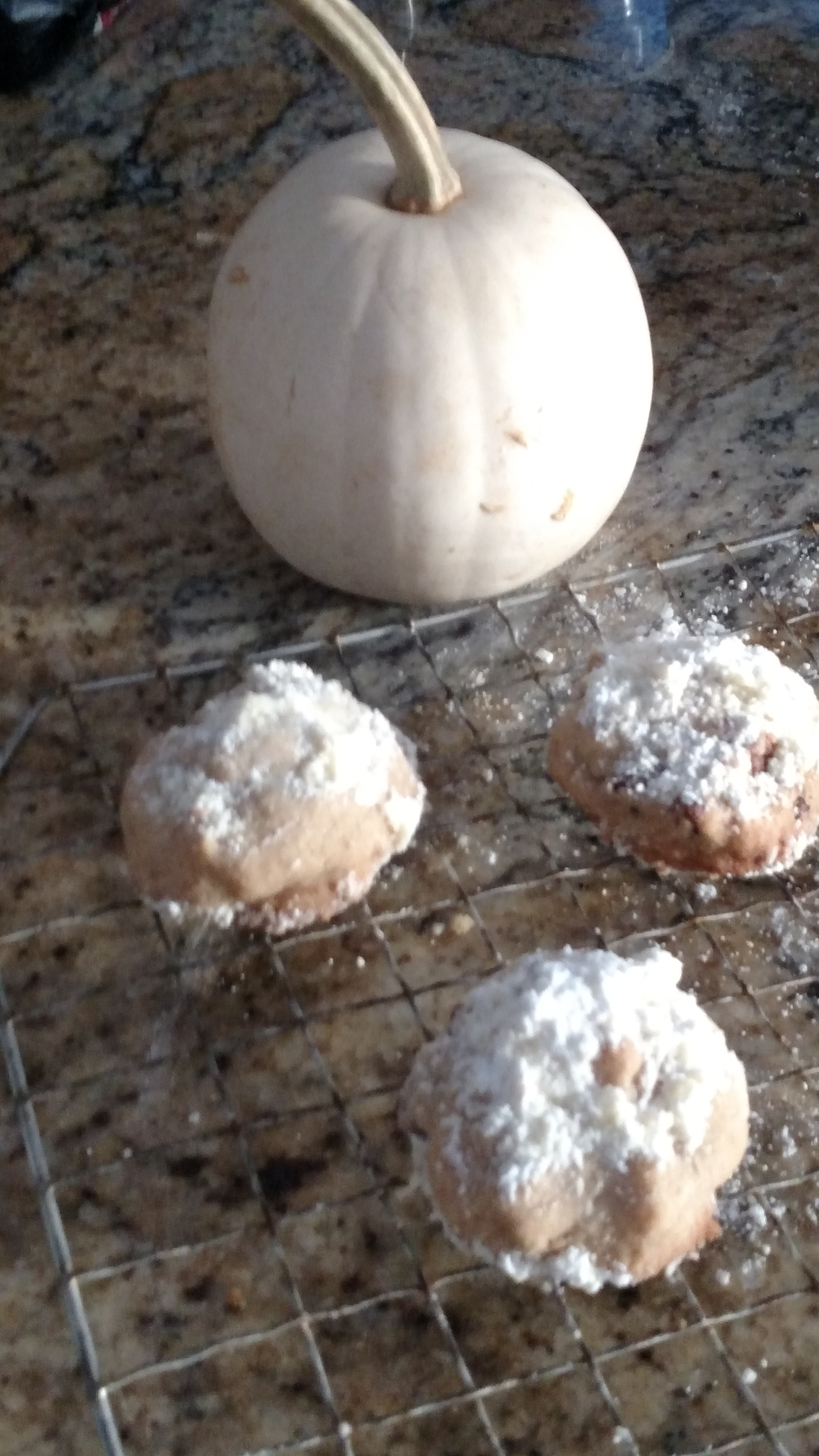
In particular, COOKIES!  How I wish I could be strong like so many of the gorgeous women I see on Facebook, and go for that extra workout during times of stress.  But Madam Cheeky heads for her staples:  Butter and Sugar.  Food is still my weakest link and I am really striving to move toward a healthier body in Recovery.  For now, though, oh my GOD, the cookies are delicious!  This week I baked a batch of – are you ready – Brown Sugar-Pecan Shortbread Cookies – and friends, they did not disappoint.  Here is the recipe for you, courtesy of The New York Times:

[/recipe]

Ingredients:

  • 1 1/2 cups four
  • 1/4 cup corn starch
  • 1/4 teaspoon alt
  • Pinch of clove
  • 2 sticks (8 ounces) unsalted butter, at room temperature
  • 3/4 cup packed light brown sugar
  • 1/2 cup finely ground pecans
  • Confectioners’ sugar

Directions

  1. Sift together flour, cornstarch, salt and clove.
  2. Using a mixer fitted with a paddle, beat the butter and sugar on medium speed until smooth, about 3 minutes.  Stop the mixer to scrape down the sides.  Add the dry ingredients and mix on low speed just until incorporated.  Add the pecans and mix just until combined.
  3. Place the dough on a sheet of plastic wrap.  Cover with another sheet of plastic and shape into a square (I was too lazy for this step).  Refrigerate for 30 minutes.  Roll the dough between the plastic to 1/4-inch thick, and into a 9 1/2 x 11-inch rectangle.  Refrigerate for a t least 1 1/2 hours, or up to 2 days.
  4. Position two oven racks so they divide the oven into thirds.  Preheat the oven to 350 degrees.  Line two baking sheets with parchment paper.  Discard the plastic sheets from the dough.  Trim the edges to form a 9 x 10.5/2-inch rectangle, then cut the dough into 1 1/2-inch squares.  Place the squares on the baking sheets, then, with a fork, pierce each cookie twice all the way through.  Bake for 18 to 20 minutes, rotating the sheets from top to bottom and front to back after 9 minutes.  If desired, dust the cookies with confectioners’ sugar while still hot.  Transfer to a rack to cool.

Adapted from “Baking:  From My Home to Yours,” by Dorie Greenspan